
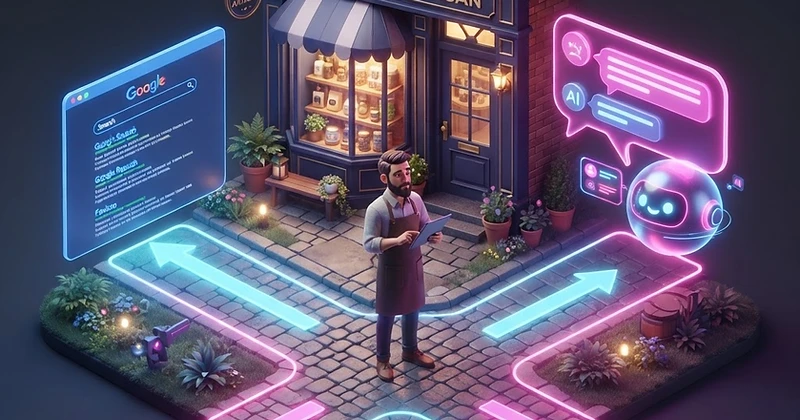
AI is not changing how small businesses market — it is changing how customers find, choose, and buy from them. The businesses that win the next decade will not be the ones with the biggest ad budgets; they will be the ones an AI can read, recommend, and book. This playbook is the map.
The Shift: From “Do Your Own Research” to “Generate My Answer for Me”
For twenty years the customer journey was a straight line: type a search term, scan blue links, click a website, fill out a lead form. Marketing was the art of being the link they clicked. That world is dissolving in real time. Today a customer asks a question in plain English and an AI generates the answer — often without a single click. Zero-click searches went from roughly 5% to nearly 50% in under a year. The click you optimized your whole strategy around is quietly disappearing.
Here is the analogy we keep coming back to: personal AI agents are to websites what electric cars are to gas stations. A gas station does not stop existing because of EVs — but its reason for existing, and the route drivers take to find it, fundamentally changes. Your website is not dead. But the road customers take to reach it is being rebuilt around a new vehicle: an AI that reads, recommends, and increasingly acts on behalf of its owner.
The old journey was search term → website → lead. The new journey is conversation → AI answer or recommendation → AI books it. In the old world you optimized a page to win a click. In the new world you optimize a business to win a recommendation — and, increasingly, a completed transaction you never see a visit for. The marketing budget that used to buy rankings now has to buy something fuzzier and more valuable: being the answer.
That sounds abstract, so let’s make it concrete. If a customer asks their phone, “find me a tattoo shop near me that does custom sleeves and has openings this week,” an AI now answers that. It either names your shop, with availability and a booking link it can complete, or it does not. There is no second page of results. There is no “load more.” You are in the answer, or you are out of the conversation.
Up from ~5% in under a year — half of all searches now end on the results page.
Seven priority-ordered moves take a business from invisible to AI-recommended.
Each spoke goes deep on one part of the shift from clicks to citations.

The Six Parts of the Playbook
This hub is the master overview. The six spokes below each go deep on one part of the shift. Read the hub for the map; jump into a spoke when you are ready to execute on that piece. Every spoke links back here, and each connects laterally to the next, so the whole thing reads as one argument.
Zero-click searches went from roughly 5% to nearly 50% in under a year. That is not a blip — it is a regime change. Customers used to research you; now they ask an AI and take its answer. The business that used to win the click wins the citation instead, and the business that never gets cited simply does not enter the conversation. Your website still matters, but the decision about whether a customer ever sees it is increasingly made by a model, not a person. Read the full breakdown. Read more
Agentic commerce — A2A, agent-to-agent — is not a 2030 concept. Personal AI agents are already booking restaurants, dentists, and house cleanings on behalf of their owners, completing the entire transaction without the human ever opening your site. If an AI agent cannot read your booking link, see your availability, and confirm a price, you are invisible to the fastest-growing booking channel in the world. The gap between 'bookable by a human' and 'bookable by an agent' is where the next wave of revenue lives. Read more
Some businesses get read by AI cleanly; others get read as a jumble of JavaScript an agent cannot parse. The difference is not a redesign — it is structure. Structured data, an llms.txt file, consistent entity information across the web, and pages designed so a machine can read them on behalf of a human are what make you legible to the answer engines. The website is not dying; it is becoming one of several catalogs a business maintains — and the machine-readable one wins. Read more
AI does not want your blog posts. It wants your answers. The businesses that get recommended are the ones publishing real, conversational answers to the real questions their customers ask — pulled from call logs, DMs, and intake forms — in a format an AI can quote verbatim. And pricing matters more than ever: hide your prices and you are invisible in a data-driven era, because no model will recommend a business it cannot compare. Everything you publish is now training data for the next internet. Read more
SEO ranks pages; GEO gets you quoted inside the answer. ChatGPT, Perplexity, and Gemini pick the businesses they recommend based on citation-worthiness — structure, corroborated facts, fresh dates, direct answers, and a reputation trail of reviews and mentions. Local GEO is its own game: winning 'near me' when nobody types 'near me' anymore. The good news is that a small business that is structured, cited, and consistent can outrank a bigger competitor that is none of those things. Read more
Rankings and traffic dashboards under-report reality in a zero-click world — a customer can find you, choose you, and book you without your analytics ever seeing a visit. The new metric is AI share of voice: how often you show up when an AI is asked about your category in your area. You can measure it with free manual prompt audits today and paid tools tomorrow, and you should re-run it quarterly the way you used to track rankings. What gets measured gets defended. Read more
The 7-Point AI-Era Action Framework
If you remember nothing else, remember this. Seven moves, in priority order, that take a small business from “invisible to AI” to “the business an AI recommends.” Each maps to a spoke above.
- 1Publish pricing content
Hiding prices hides you from AI. Publish at least ranges, starting-at prices, and tiers — in plain text and Offer schema.
- 2Audit scheduling for AI-agent readiness
Make sure a model can find your booking link, read availability, and complete the transaction end-to-end.
- 3Mine customer questions into content
Pull the real questions from call logs, DMs, and intake forms and turn them into an answer library with FAQPage schema.
- 4Build a knowledge catalog
Stand up structured data, an llms.txt file, and consistent entity information so AI can read you without scraping.
- 5Optimize for AI citations
Lead every page with a direct answer, back claims with data and sources, and keep content fresh and dated.
- 6Treat all content as training data
Everything you publish teaches the models. Write it to be quoted, not just to be clicked.
- 7Measure AI share of voice
Re-run your visibility score quarterly and track how often you show up when an AI is asked about your category in your area.
The framework is deliberately small. A solo owner-operator can run all seven in a quarter. A team can run them in a month. The point is not to do everything at once — it is to stop guessing and start with the one thing that tells you which of these you actually need first.
See where you stand — run your free AI Visibility Score
Our free tool scores your site the way the answer engines do: AI-crawler access, structured data, entity clarity, citation signals, and booking & pricing readiness. It hands you the exact gaps behind the seven moves above, in priority order.
Run your free AI Visibility ScoreThe Small Business AI Survival Kit
The checklists, prompts, and 90-day action plan from this playbook in one downloadable pack. Drop your email and we’ll send it to your inbox.
- The complete 7-point AI-era action framework (priority-ordered)
- A step-by-step 90-day action plan with clear milestones
- 6 playbook chapters, each with implement-now action items