
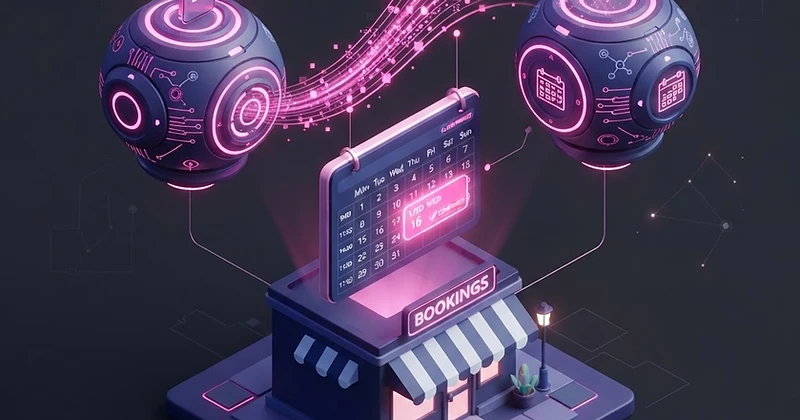
Agentic booking is not coming. It is here. Personal AI agents are already booking restaurants, dentists, and house cleanings on behalf of their owners — completing the whole transaction without the human ever opening your website. If an agent cannot read your booking link and confirm a price, it books the business it can. Yours or a competitor’s.
A2A Commerce in Plain English
For twenty years, e-commerce was B2C or B2B — a human on one end, a business on the other, a website in between. Agent-to-agent commerce, or A2A, adds a third party: the customer’s AI. The customer says what they want; their AI reads availability, compares options, and completes the booking or purchase. The business’s system confirms it. Two agents shake hands. The human is the owner of the request, not the driver of the clicks.
This sounds futuristic until you watch it happen. A customer tells their phone, “book me a haircut at the place I go, next available after work.” The phone’s agent pulls that shop’s availability from a recognized booking platform, confirms the stylist and time, and holds the slot. The customer taps once to confirm. No website. No search results. No competitor’s page. The shop that is machine-readable got the booking; the shop that buried its calendar behind “call us” did not even enter the running.

What Is Already Bookable by Agents Today
Not everything — yet. But the categories where agentic booking already works are exactly the categories small service businesses live in:
- Restaurants & reservations — OpenTable, Resy, and Reserve with Google let an agent read availability and hold a table.
- Salons, spas & barbers — Booksy, Vagaro, Fresha, and Mindbody expose machine-readable availability and pricing.
- Health & dental — scheduling platforms with confirmable slots an agent can follow.
- Home services — cleaning, repair, and quoting tools with structured availability and pricing.
- Consultations & sales calls — Calendly, Cal.com, Acuity, and Chili Piper give an agent a clean booking path.
The pattern is the same in every category: the business on a recognized, structured platform gets read; the business on a custom “contact us” form does not. The platform is the bridge; your presence on it is the toll.
| Category | Agent-readable platforms | What an agent can do |
|---|---|---|
| Restaurants | OpenTable, Resy, Reserve with Google | Read availability and hold a table |
| Salons & spas | Booksy, Vagaro, Fresha, Mindbody | See slots, confirm stylist and time |
| Health & dental | Confirmable scheduling platforms | Match service and hold an appointment |
| Home services | Cleaning, repair, quoting tools | Read structured availability and pricing |
| Consultations | Calendly, Cal.com, Acuity, Chili Piper | Follow a clean booking path end-to-end |
Can an AI Agent Book YOUR Business Today? — A 5-Point Test
Run this on your own business right now. Score one point for every “yes.”
- 1.Real booking link. Is there a recognized scheduling platform (Calendly, Booksy, Square, OpenTable, etc.) a model can follow — not a “call us” gate?
- 2.Machine-readable availability. Can an agent see open slots without filling out a form or calling?
- 3.Confirmable price. Is there a starting price or tier an agent can confirm before booking?
- 4.A clear “Book” action. Is there a recognizable Book / Reserve / Schedule button an agent (and a human) can identify instantly?
- 5.Structured service data. Does schema describe what you offer so an agent can match your service to its owner’s request?
Why Waiting Is Expensive
New channels do not arrive on a schedule; they hit on a curve. Voice assistants, food delivery, and streaming all looked like niche curiosities until they were not — and the businesses already plugged in when the curve bent took the lion’s share. Agentic booking is on that kind of lightning-strike adoption curve. The cost of waiting is not measured in the bookings you miss this month. It is measured in the compounding share you lose to the competitor who was machine-readable first.
There is also a defensive angle. The businesses that get readable now teach the models what “bookable” looks like in their category. By the time agentic booking is mainstream, the models have already formed habits about who is easy to book and who is not — and those habits are sticky. Early infrastructure buys you a runway, not just a booking.
The Bridge to Machine-Readable Infrastructure
Agentic booking is the visible front end of a deeper requirement: being machine-readable. An agent cannot book what it cannot read. That means structured data, a booking platform that exposes availability, pricing an agent can confirm, and a consistent identity across the web so the agent knows it is booking the right business.
That is the bridge to the next spoke. If agentic booking is the “what,” the machine-readable business is the “how.” It explains why AI reads some businesses cleanly and others as a jumble of JavaScript it cannot parse — and what to do about it without redoing your whole website.
Can an AI agent book your business today?
Our free tool scans for exactly the five things above — a real booking link, machine-readable availability, confirmable pricing, a clear Book action, and structured service data — and scores your agentic-booking readiness against the competition. See your gaps, fix in priority order.
Run the AI readiness auditThe Small Business AI Survival Kit
The checklists, prompts, and 90-day action plan from this playbook in one downloadable pack. Drop your email and we’ll send it to your inbox.
- The complete 7-point AI-era action framework (priority-ordered)
- A step-by-step 90-day action plan with clear milestones
- 6 playbook chapters, each with implement-now action items